JUST WONDERING HOW YOU WOULD CITE EMOJI IN APA?
Just Wondering How You Would Cite Emoji in APA?
Gene Lyman
LRC696D—Perry Gilmore
November 12—December 7, 2017
Introduction
This essay is an informal extension of my personal interest in the structural, functional and semiotic transformations of language found in computer-mediated communication (CMC). In the fall of 2016, I drafted a literature review covering what I called “literacies of IM/SMS”, that is, local literacies rooted in the use of a form of English that had co-evolved in (largely U.S.-based) instant messaging applications and (mostly European) cell-phone chat. My original thought with this document was to extend my prior research, by exploring the pragmatics of emoticons and emoji as auxiliaries to what David Crystal refers to as “textspeak” (Crystal, 2008, p. 187). Additionally, I’d hoped to suggest some original lines of research stemming from the apparent replacement of text-generated (and therefore writer-generated) generated “emoticons” by more complex, multimodal and—notably—corporate-specific, emoji.
Instead, I found myself wrong-footed (with both feet, at that) by two errors: first, I’d made a glaring omission in my personal review of the literature. An entire book had been published the previous summer: The Semiotics of Emoji: The Rise of Visual Language in the Age of the Internet, by Marcel Danesi. My second error—more embarrassing to me—was my misunderstanding of how emoji came into common use. Though emoji were widely introduced to English-language CMC by Apple in 2011 (Stark & Crawford, 2015), they had been in use in Japanese-language CMC for nearly a decade. Also, much as certain features of IM/SMS language evolved in parallel on American IM software and European cellular chat, emoji were created to perform many of the same functions as emoticons –but for a sociocultural context that does not default to the Roman alphabet.
So, in the spirit of Erving Goffman, this is a scholarly excursion into the realm of adorable social media pictographs and ideographs. This is intended as a face-saving offering (to my instructor, my colleagues and myself) and as a more solid footing for examining emoji and other elements of multimodal text-speak in discourse analysis going forward. I’ll be using Jan Blommaert’s positions on historicity and the polycentric ordering of indexicality in discourse as a window into the role emoji play in my own current English-language CMC environment.
A large corpus of popular and scholarly literature exists on emoticons and emoji. It derives, to some extent, from an even larger corpus on IM/SMS in general. My rapid—and admittedly, somewhat shallow—review of peer-reviewed articles on emoticons/emoji suggests that most current research focuses on their linguistic features. Sociolinguistic and ethnographic analysis of emoticons/emoji appears to be a secondary topic although there some exceptions (see Baman, Eisenstein and Schnoebelen, 2104; Bolander and Locher, 2014; Ogletree, Fancher and Gill, 2014; and Stark and Crawford, 2015). Danesi (2017) also provides an extensive—though mostly high-level—overview of emoji grammar, pragmatics and semantics.
Because my focus is to apply specific concepts in discourse analysis developed by Blommaert to the topic of emoji in CMC, I will only be referencing brief elements of the literature within that scope. This is arbitrary and self-imposed, however; it’s important to note a much larger range for discussion is available.
The surface of computer mediated communication changes rapidly. In popular discourse, as well as to a lesser extent in academic discourse, trends in discussion tend to follow these surface changes. With the exception of the occasional article in a genre I loosely define as “X is Y years Old” (for an example, see Bignell, 2012) popular coverage of CMC largely revolves around the novel, the controversial and the “how-to”. Academic writing on various aspects of CMC[1], such as IM/SMS language, or emoticons/emoji, is more aware of historical developments, but again, much of the focus is on a specific phenomenon or usage at the current moment. Generally, however, aside from a pro-forma background summary, the historical aspects of CMC phenomena are usually elided.
Blommaert (2005) has labeled this effect in discourse as “sychronicity”. The effect of synchronicity is to conceal the fact that features of discourse “operate on different scales, have different origins, offer different opportunities, and generate different effects” (Blommaert, 2005, pp. 128-129). In short, present categories of analysis may address the readily accessible history of an area of discourse, but are also likely to conceal any historical realities that do not contribute to its current state. As a result, differences in discursive stance rooted in less accessible historical positions are marginalized or ignored (Blommaert, 2005, p. 130).
Counterbalancing synchronicity, Blommaert proposes the concept of “layered simultaneity” that is: any moment of discourse references multiple layers of historicity that result in it being “…overdetermined, so to speak, by sometimes conflicting influences from different levels of historical context” (idem, pp. 130-131). Taken together with synchronicity, an understanding of layered simultaneity means that any examination of discourse must examine discourse on history, that is, those aspects of tension and incoherence that stem from “references and pointers to [indexes of] a variety of historical time-frames” (p. 136), as well as discourse from history, that is from “a particular…or various shifting positions—in history” (ibid.).
Indexicality is the relationship between a sign and its referent in a specific context (deixis). Indexicality is ordered, in the sense that in addition to the immediate or pragmatic (first-order) meaning(s) of a sign-referent relationship, that relationship invokes a wider range of concepts (second-order indexicality). This means indexicality is not necessarily stable—one sign may index multiple referents either simultaneously or at different times—nor is it necessarily direct, being in some cases simply indicative, or inferential. Nonetheless, in social contexts, indexical ordering provides “recognisable (sic) semiotic emblems for groups and individuals, a more or less coherent semiotic habit” (Blommaert, 2007, p. 117). Blommaert argues that indexical orders are themselves, in turn, ordered, in the sense that there are stratifications of semiotic—and social—rank among systems of signs and their referents. In effect, orders of indexicality dictate how particular systems of reference (forms of semiosis) are valued in hierarchical relation to one another. Variant ways, modes and means of communication are, therefore, valued more or less highly and can reflect the perceived value—in context—of the individuals or groups that employ them (idem, p. 118).
Blommaert further argues that the authority—or hierarchical status—of any given order of indexicality derives from hypothetical standards of evaluation he describes as “real or perceived ‘centres’ (sic) to which people orient when they produce an indexical trajectory in semiosis” (ibid.). These ‘centers’ define when, where, how, by what methods and in what registers particular topics are discussed. Although a given discursive situation may be ‘polycentric’—that is, with different participants orienting their discourses to different, or multiple, centers of authority—Blommaert notes: “The multiplicity of batteries of norms does not mean that these batteries are equivalent, equally accessible or equally open to negotiation” (idem, p 119). In effect, some centers of authority (and their related orders of indexicality) are “bigger” than others in specific discursive contexts—though multiple centers may still be in play for the participants.
So how do Blommaert’s observations come to play in my thoughts about CMC? First, I’d like to point out that many recent topics of discussion around Computer mediated communication (CMC) turn out to be rooted in technologies and discursive practices nearly half a century old. There are several relevant examples: the technical protocols underlying electronic mail have existed in their current form since 1973 (Bhushan, Pogran, Tomlinson & White, 1973; Left, 2002); instant messaging (IM) applications such as Google Hangouts and Facebook Chat descended from one-to-one messaging programs developed in the 1970’s and 1980’s (Krol, 1992; LaGesse, 2001; Latzko-Toth, 2010). Cellular short message service (SMS) generated convergent and parallel messaging practices with instant messaging (IM); the two discourses effectively merged as more advanced cell phone networks (2G, 3G, and 4G) became available (Agar, 2014; Crystal 2008). Finally, many “Web 2.0” social media applications, such as Facebook and Twitter are, functionally, the equivalent of prior one-to-many communication protocols, only revised and re-layered atop the World Wide Web (Berners-Lee & Fischetti, 1999; Krol, 1992). Instead of subscribing to a mailing list or a USENET newsgroup, one designates “friends” or “follows” particular individuals or topics. One can then read messages of interest and post replies as one sees fit and as the individuals managing the queues permit.
Of course, CMC media and practices have changed over time: sometimes in response to improvements in technology (Instagram photographs need not be shared in Uuencoded text-chunks, for example) other times in response to limitations (the more extreme abbreviations in SMS likely arose from typing on a twelve-key cellphone keypad). Nonetheless the technological history of CMC discourse is as much one of changing surfaces—text emails with binary file attachments now appearing as multimedia emails, subscription-only email lists now manifesting as friends-only Facebook lists, and so on—as it is of breakthroughs in computer programming or the arrival of genuinely “new media[2]”. The largest changes in CMC in recent history have been related to social and cultural contexts: who provides the CMC channels and how they provide them, as well as who uses CMC and how they use it.
This assessment of the sociocultural shift in CMC context loosely mirrors—in the sense of being an inverted reflection of—David Crystal’s shift in his discussion of “netspeak”. In his 2001 book, “Language and the Internet”, Crystal argued that various form-and-structural shifts in online writing heralded the arrival of a new linguistic medium (Crystal, 2001, p. 239). Crystal later partially revised this thesis: many of the distinctive formal features of “textspeak[3]”, such as initialisms, logograms, and forms of word shortening, turned out to have precursors in older, printed formats. These had, nonetheless, been given new currency and importance by their migration into a new technological and social space (Crystal, 2008). I assert this movement is, in fact, bi-directional. Modes and methods of computer-mediated-communication became more widely available, and migrated into pre-existing social spaces, thereby shifting their sociocultural and economic context. One consequence of this synthetic movement was a wider range of linguistic variations—both novel and repurposed—became more visible in CMC. On becoming more visible these variations spread, and were identified and evaluated.
And, in many cases, these variations were “evaluated” and found wanting. Crystal (2008) noted a “remarkable number of doom-laden prophecies” that arose as IM/SMS language became a popular modality of CMC. Thurlow (2006) describes the popular reaction as “moral panic”. I would argue this was a reaction to the transformation of the IM/SMS user base. Earlier use of CMC was most common among computer experts, who formed a relatively “elite” subset of the general population. As dial-up Internet access became more affordable and cell phone usage increased IM/SMS allowed relatively inexpensive, instantaneous and—from a hierarchical perspective—unregulated communication by a less socially powerful group (youth) unhindered by physical barriers or distance (Carrington, 2004; Crystal 2008). The status of language practice related to using CMC shifted in terms of the (assumed) power and status of those using it. Carrington (2004) observed: “[A]dults…drawing on the sanctioned authority afforded them, decide which texts, literacies and therefore the kind of identities…to which young people will be entitled” (Carrington, 2004, p. 225).
Borrowing from Blommaert, we might say the adults who were watching—and commenting on—youth adoption of CMC exaggerated the importance that younger users assigned to the orders of indexicality backing IM/SMS language and practices. The resulting controversy over IM/SMS as a “threat to literacy” can be understood as a reactive insistence on the monocentric discursive authority of an imagined “conventional” order of indexicality for literacy in English. The fact that academic research could not establish a generalizable causal or correlative relationship—in either direction—between literacy in IM/SMS language features and the conventions of more formal written language was less important than the imagined reversal of social authority. In other words: to the orders getting out-of-order.
Now—at last—to emoji! Once again, I’m going to insist on doing some historical digging, that I hope will help to frame our understanding of their use in current CMC.
As I’ve previously noted, emoticons and emoji are an instance of ‘parallel evolution’ in computer-mediated communication. Emoticons are paralinguistic ideographs, created by combining punctuation and symbols from the Roman alphabet. In CMC, emoticons make explicit the perlocutionary intent of an online message by providing information about its tone or emotional context. The history of such “emotional punctuation” arguably has precedent, or at least suggestions for precedent, in print media as well (Stark & Crawford, 2015, p. 3). In the context of CMC, however, the “official” origin of emoticons has been traced to 1982, when Scott E. Fahlman suggested :-) as a “joke marker” on a Carnegie Mellon email list (Garrison, Remley, Thomas & Wierszewski, 2011, p. 114; Stark & Crawford, ibid.). The type and numbers of emoticons[4] has proliferated since Fahlman’s original email suggestion, and they are now used for a broader range of communicative functions (Danesi, 2017; Dresner & Herring, 2010; Garrison, Remley, Thomas & Wierszewski, 2011).
Emoji arose out of emoticons’ limitations where the Roman alphabet was not the default. In Japan, a parallel set of paralinguistic markers emerged in the form of kaomoji (“face marks”). Some of these were, in turn, adopted in Western IM/SMS as “vertical emoticons” –a widely known example is o_O, indicating confusion or astonishment. Full use of kaomoji in English CMC requires access to a Japanese character set, however; moreover, from a Japanese standpoint, kaomoji are inefficient, requiring more keystrokes to convey the same information as emoticons (Blagdon, 2013; Dresner & Herring, 2010, pp. 249-250; Stark & Crawford, p. 3).
In 1998, Shigetaka Kurita developed a set of “picture characters” for the Japanese telecom company NTT Docomo that he hoped would fulfill many of the communicative functions of kaomoji more efficiently. By coincidence, “picture characters” in Japanese adapts most readily into English as e (picture) moji (character or mark), forming a useful—but false—cognate with “emoticon” (Blagdon, 2013; Danesi, 2017).
Emoji became a global phenomenon starting in 2008, when Apple added an emoji keyboard to iPhones as part of its corporate strategy for the Japanese telecom market. This fueled an interest in the novel (to international users) and colorful new characters; American users began to hack their iPhones to access them (Stark & Crawford, p. 5). The Unicode Consortium, the authoritative organization for computer character encoding, adopted an international standard for emoji coding in 2010 (Unicode Blog, 2010). Apple made its emoji keyboard available as a general feature on iPhones in 2011 (Stark & Crawford, ibid.).
Currently, the Unicode Consortium “owns” the data encoding standard for emoji, but the graphics used to depict each emoji character belongs to individual corporations (Unicode Consortium, “Emoji and Pictographs”). The types of emoji characters—which were always somewhat more extensive than emoticons—has also grown to encompass depictions of objects, animals, and concepts. Consequently, the discursive role of emoji is now considerably larger than that of emoticons, and an entire website, https://emojipedia.org/, has emerged simply to track this ongoing expansion, both in usage and in the variety of graphics available.
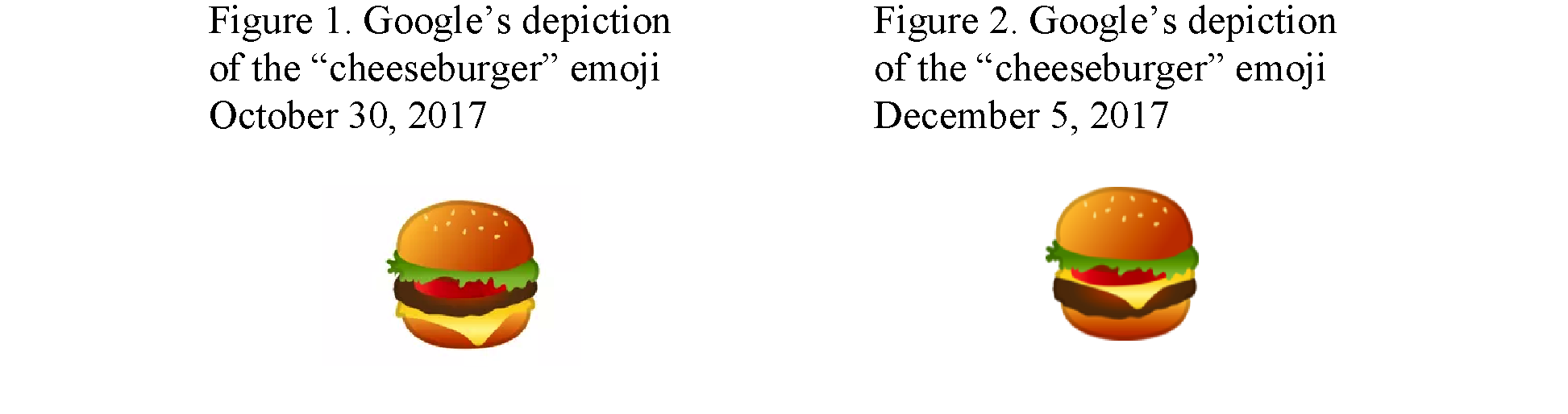
Emoji are now popular enough to lead to passionate—and somewhat arcane—debate: for example, consider the recent controversy over Google’s depiction of the “hamburger” emoji (Ricker, 2017). The reaction to Google’s depiction of this one food item was sufficiently heated that the company released a new version in Google Android 8.1 (https://emojipedia.org/google/android-8.1/changed/).
How to think of this? On the one hand, we could view it as a triumph of popular taste over corporate inertia—except, it probably cost Google almost nothing to redesign its cheeseburger graphic: the code standard is locked into place by the Unicode Consortium, so no reprogramming was needed. Also, when a user sends a “cheeseburger” emoji from a Google Android device to an iPhone, and the recipient will see Apple’s graphic anyway. Additionally, the entire topic of how an emoji is rendered can be, and often is, viewed as trivial in comparison with “serious” cultural or political news. For example, an (apocryphal) criticism aimed at Fox News[5] concerned its alleged coverage of “Burgergate” instead of a criminal indictment embarrassing to the Trump administration (Snopes, 2017).
Viewing emoji through the lens of Blommaert’s concept of layered simultaneity, the use of emoji in CMC turns out to be discursively complex. Once again, the issue is not emojis’ linguistic features—which turn out to be quite complex. In addition to replicating the perlocutionary functions of emoticons, emoji enable practices such as rebus writing, calquing, and other multi-modal enhancements of text in CMC (Danesi, 2017). Rather, emoji—at least in English language CMC—inherit the same historical shift from being a relatively elite practice (you no longer need to be a ‘hacker’ to use them) to a popular one. Viewed in terms of Blommaert’s discussion of orders of indexicality, emoji inherit many of the same issues as IM/SMS language in general. They are a popular feature in a popular discursive frame associated with informal communication among youth. Moreover, they appear “pop-art-ish” from a Western aesthetic frame. This is a legacy of Shigetaka Kurita’s decision to work around the limitations of 1998-era graphics processors by adopting semiotic practices based on Japanese comic books (Blagdon, 2013; Danesi, 2017, pp. 41, 72). What started as a clever technical hack was (figuratively) “lost in translation” for a Western audience. In addition, Stark and Crawford’s 2015 Marxian analysis highlights how “market logic” has been used to frame emoji as a “means to lure consumers to a platform…and to express a normative, consumerist, and…cheery world view” (Stark & Crawford, p. 8). The critically panned children’s film, The Emoji Movie, is perhaps the most recent and blatant example of this (IMDB, 2017).
One final factor that may play a rule in social devaluation of emoji usage is an association of emoticon/emoji (in fact, emotive expression in CMC generally) with female interlocutors (Baman, Eisenstein and Schnoebelen, 2104; Ogletree, Fancher and Gill, 2014). The extent to which women’s contributions to discourse are valued or devalued, as well as women’s own self-perception of how they wish to communicate—what concept of their own voice(s) women choose to apply—partially determines which orders of indexicality to which emoji are perceived to belong. Very recent research by Chen et al. (2017) suggests an emerging divergence in gender-conforming use of emoji, however. If, in fact, distinctively “male” and “female” patterns of use emerge, one possible topic of future studies might be an examination of whether or not the “male” pattern came to be referred to a “higher” center of authority.
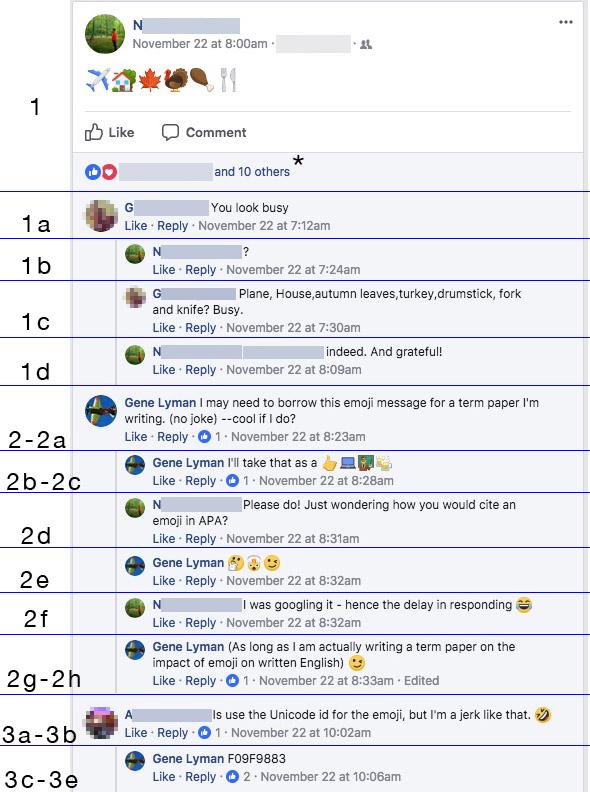
The following example is taken from my personal Facebook account—a piece of my own personal corpus of CMC. Serendipitously, it allows me to apply Blommaert’s concepts to emoji use in a “real” context and in light of my own foregoing observations. I have anonymized all participants other than myself, and obscured any identifying location information or images containing recognizable faces. I’ve also added coding to the example to indicate major conversational “turns”. Two anomalies, artifacts of the Facebook platform, should be noted:
Figure 3. Facebook exchange dated November 22, 2017
I’ve known N___ for over thirty years, although we only decided to communicate again, using Facebook, about three years ago. His Facebook posts are often multimodal—most often photographs, or several photographs—with an accompanying verbal caption. Some, although not all, of his verbal posts could be described as “peppered with” emoji, but this is the first exclusively emoji post I’ve seen N____ make. Nonetheless, N___ very clearly thinks of Facebook as a multimodal messaging platform. My best guess is that N___ wanted to convey he was in a good mood about travelling home by sending an ideographic/multimodal message (which would also be in line with his general decision to use Facebook as a multimodal communication channel).
The following conversational turn with G____ is entirely text, however. I don’t know G___ personally, but information from his Facebook page indicates he is an older person, possibly more conservative, and possibly a professional acquaintance of N___’s. The swap into plaintext may indicate G___’s preference, as an older interlocutor, for exclusively text conversation, though his entirely literal transformation of N____’s emoji message may also mean he “gets” a sense of N____’s positive energy—and busy holiday schedule—from it. Of the three conversational turns, this one most resembles the older, pre-emoji paradigm for IM conversations. It is also the only conversation turn in which no “thumbs up” or “like” emoji are present as a reaction at any point in the turn.
Arguably, next to N____’s original post, this turn makes the most expressive use of emoji. I’m engaging here self-consciously at two levels: first I know it is likely my request to use a Facebook post for a paper (on emoji, no less) will be perceived as somewhat unusual. Hence my “no joke” statement in my conversational opening. I’m also, in an apparently self-contradicting manner, replying to N___’s conversational sub-turns with primarily emoji statements of my own. There are a couple of inside jokes here: one having to do with my general conservativism in my personal use of CMC (like G___, I generally text in text; the other is related to N___ and I both finding ourselves in graduate school later in life (hence his reference to the APA style guide).
My last turn in the exchange is meta-commentary on the fact I’m attempting academic analysis of what may seem like an unlikely topic. The indexical order of the turn keeps shifting: I am asking N___’s permission to use his (casual, in theory, low-value) discourse on holiday travel as a topic in an academic paper (high-value discourse); N___’s response references the fact that he is also an academic and is wondering how I will ‘cite’ emoji based on the APA 6 Publication Manual (perhaps the ‘highest’ center of discursive authority in our respective fields). My responses, both at turn 2e, in emoji, and at 2g, in mixed IM/SMS language and emoji is meant to indicate the shift may be difficult, but I will figure out how to do it. N____’s intervening response “…I was Googling it” is meant both as encouragement and teasing. In effect “I’m sure you can find the answer, but this is still a funny idea.” In short, we are adopting a casual approach to an (in theory) serious question: how do you apply a “high” center of discursive authority to a more casual (and lower-valued) mode of discourse? Our code-switching crosses both languages and levels of discourse: simultaneously participants in the “higher” (etic, academic) perspective and the emic perspective of being CMC/emoji users.
Turn 3 analysis
This last conversational turn introduces, serendipitously, another center of authority –specifically, the Unicode Consortium. I only know that A____ is a friend (or Facebook acquaintance) of my friend N____. His assertion at turn 3a contradicts itself “I—here, I am filling in for an apparent error, ‘Is’, in the original—use the Unicode ID for the emoji…” followed by a contextually appropriate emoji character (not Unicode). His interpolation “but I’m a jerk like that” is perhaps, intended as a face-saving offering: A___ would have no idea if I am familiar with the relationship between Unicode and emoji. After all, I made no reference to this relationship in my prior conversational turn with N___. Without saying this is what A____ means, one interpretation might be: this is an attempt to “show off” knowledge at a computational level without offending the English majors in the audience.
Again, purely serendipitously, this set me up to deliver the punchline. Admittedly, an arcane punchline, but a punchline nonetheless: “F09F9883”—raw hexadecimal code for the emoji symbol “😃”. It’s a computer-nerd joke par excellence, and the truth is, it may have shut down further conversational turns (unicode.org, 2017, translated to hex by http://dev.networkerror.org/). Nonetheless, both A____ and N____ replied with “thumbs up” –I have some hope my fellow participants, if they did not get the joke directly, laughed at my audacity, if nothing else.
The risk I’ve found with any academic writing (even relatively informal writing such as this) is the risk of “taking a long walk for a short drink of water.” I hope I’ve been able to demonstrate that some of Blommaert’s methods are applicable to the realm of computer-mediated communication. Of his own framework, Blommaert has noted that concepts such as polycentricity, orders of indexicality, and layered simultaneity seek to offer “an additional analytic dimension to established concepts…that allows us to investigate the ‘macro’ in the micro’” (Blommaert, 2007, p. 129). My attempt here is somewhat clumsy, and limited by the fact that many of my personal CMC conversations are, in fact, exchanges among folks like myself: college-educated white guys. Our use of IM/SMS language, emoji, etc., is framed by our knowledge of—and privileged access to—centers of discursive authority such as the APA 6 Publication Manual and the character code tables provided by the Unicode Consortium.
The wider “global” narrative that Blommaert seeks to invoke will need to be uncovered by further research into the complexities of CMC’s shift across populations and the impact that both new and ongoing centers of authority have on our interpretation of CMC discourse. My personal thoughts on this hover somewhere between the pessimism expressed by Stark & Crawford (“…emoji should be understood both as a rear-guard action to enable sociality in digital networks and also the means to quantify, measure, signal, and control affective labor.” 2015, p. 8) and the somewhat more optimistic take expressed by Crystal (2008): that IM/SMS language—including emoji—are “in some small way, language in evolution” (p. 175). Without ignoring the role played by technology advances in CMC, my final conclusion will depend very much on how IM/SMS—and its multimodal potential, examined in this essay about emoji—succeed in shifting centers of authority for the English language as a whole. To paraphrase Walter Benjamin: Elitist centers of authority view emoji as rendering CMC aesthetic within existing discursive orders. Democracy responds by surfacing and critiquing elitist centers of authority within CMC.
Agar, J. (2013). Constant Touch: A Global History of the Mobile Phone (3rd ed.). London: Icon Books.
Blommaert, J. (2005). Discourse: A Critical Introduction. Cambridge:Cambridge University Press, 2005.
Carrington, V. (2004). Texts and literacies of the Shi Jinrui British Journal of Sociology of Education, 25(2), 215-228.
Crystal, D. (2001) Language and the Internet (1st ed.) Cambridge: Cambridge University Press.
Crystal, D. (2008). Txtng: The gr8 db8 (1st ed.). Oxford: Oxford University Press.
Danesi, Marcel. (2017). The Semiotics of Emoji. New York:Bloomsbury Publishing.
LaGesse, D. (2001). Instant message phenom is, like, way beyond E-mail. U.S. News and World Report, 130(9), 54–57.
Latzko-Toth, G. (2010). Metaphors of Synchrony: Emergence and Differentiation of Online Chat Devices. Bulletin of Science, Technology & Society, 30(5), 362–374. http://doi.org/10.1177/0270467610380005
Thurlow, C. (2006). From statistical panic to moral panic: The metadiscursive construction and popular exaggeration of new media language in the print media. Journal of Computer-Mediated Communication, 11(3), 667–701. http://doi.org/10.1111/j.1083-6101.2006.00031.x
[1] With the exception of technical journals covering topics such as networking, programming or system hardware.
[2] A possible exception may be Tim Berners-Lee’s development of the World Wide Web –though its most distinctive feature (hypertextuality) is limited to some extent, I believe, in social media “apps”.
[3] Crystal periodically revises his terminology. I think his most recent term for what I call “IM/SM language” is “netlingo”.
[4] Pun intended.
[5] Plenty of non-apocryphal criticism arguably still applies, of course.